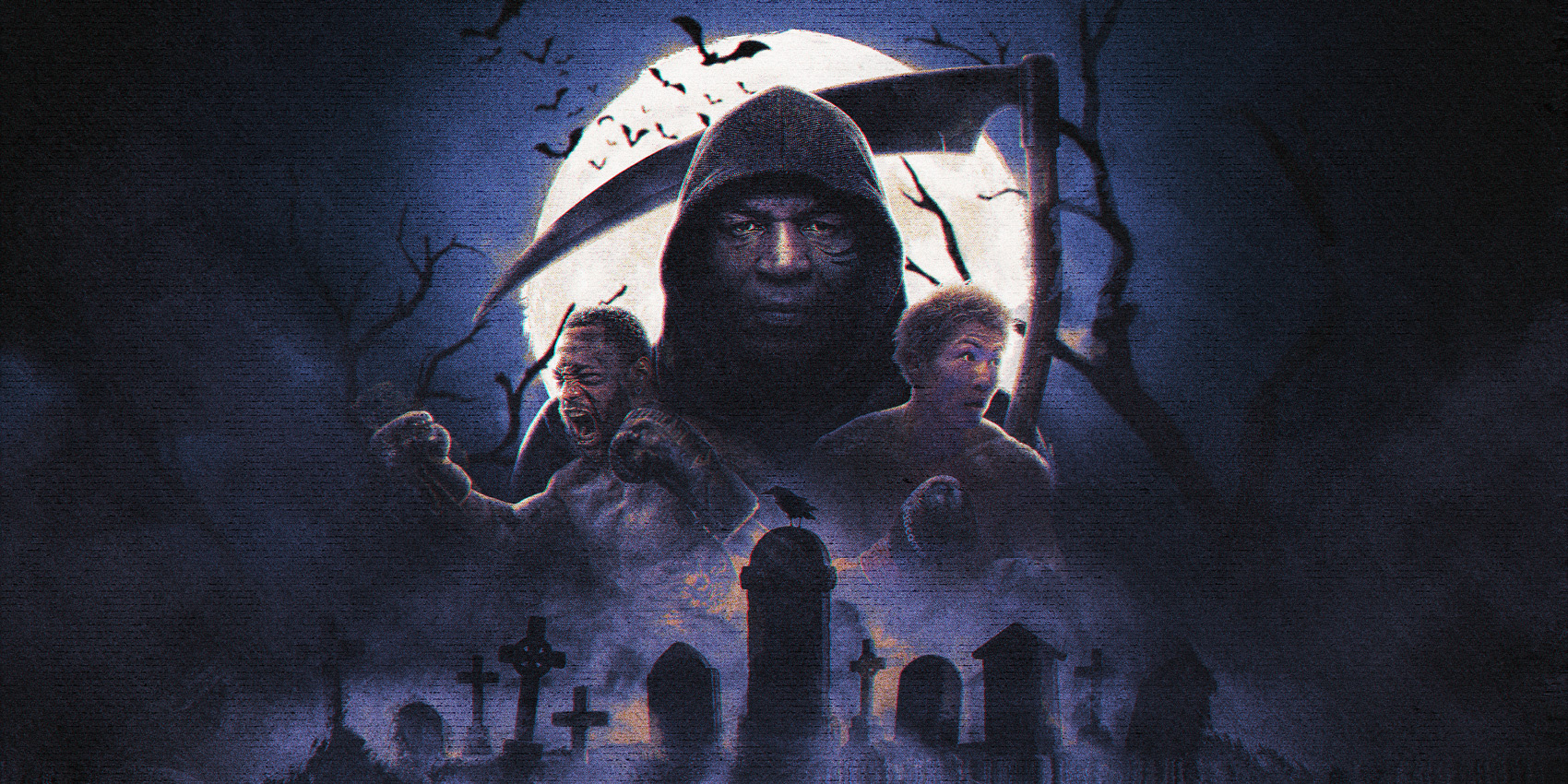
Elliot Worsell Uncrowned Thu, October 29, 2026 at 11:00 AM UTC · 26 min read About Our Ads Advertisement Advertisement Advertisement When "Iron" Mike Tyson became arguably the most intimidating boxer of the 20th century, it wasn't because he shouted the loudest, pulled the ugliest faces, or gnawed ears. He instead gained that reputation because he had learned from Charles "Sonny" Liston , his hero, and because, more importantly, he understood how a good horror film works.
Which is to say, Tyson soon realized that jump scares, although effective in certain situations, will never be as chilling as silence, unease, and dread. Moreover, he realized that in boxing, as in life, the key to generating fear in another human being is to allow their imagination to run wild, do its worst.
If in any doubt, just recall the faces of Tyson's opponents during his run as heavyweight champion between 1986 and 1990. Each of those men were conscious of Tyson's threat — his punch power, his explosiveness — but, in preparation for fighting him, had to convince themselves they would be different from all the victims who came before them. One after another they were made to stand opposite Tyson during the pre-fight introductions and watch as he eyeballed them from close range, chewing on his mouthguard like either an infant or animal. As they then remembered to breathe, they would try to forget the faces of the others and try to figure out whether the scenes of devastation they saw in Tyson's eyes — challengers strewn, stretchered out — were from the past or the near future.
Later on, of course, Tyson's capacity to scare would diminish. That, it would seem, is the fate of every fighter for whom intimidation becomes a stock-in-trade and is typically the result of someone having stood up to them and exposed them as vulnerable, human. In the case of Tyson, that person was James "Buster" Douglas in 1990, followed by Evander Holyfield in 1996. Together, they paved the way for other heavyweights to believe they could do the same. In horror-film terms, they were The Final Girl. They were Laurie Strode. They were Sidney Prescott. They represented, for Mike Tyson, the great unmasking.
And yet, though unmasked and now 60, Tyson remains the definition of "scary fighter" in the minds of the general public; his tiny black shorts and gold tooth evoking ring horrors the same way hockey masks and shower curtains evoke terror on screen. Furthermore, Tyson's unmasking, rather than signal the end, led only to sequels, remakes, copycats.
So far this century we have witnessed a handful of fighters blessed with the ability to frighten. Not like Tyson, no, but in their own distinct ways — either through the power they possess, the manner in which they carry themselves, or the difficulty decent men have standing up to them. Often you will see this ability to frighten in the eyes and hesitation of the opponent. Sometimes you can even feel it yourself. The anticipation. Chills down the spine. Sweaty palms. Shortness of breath. Fear.
Venezuelan two-division world champion Edwin 'El Inca' Valero (L) knocked out every man he fought.
Witness/victim statement: For some boxing fans, following the career of Edwin Valero was as close as they would ever get to procuring snuff films on the dark web. His fights, each of them gnarly and brief, took place in far-flung territories, sometimes off-TV, and tales of his violence were spread primarily via word of mouth. Before long, he had become boxing's Slender Man, his name whispered rather than spoken aloud.
It helped, of course, that Valero happened to be a once-in-a-generation knockout machine who, in 2006, set a new world record by winning his first 18 fights as a professional by first-round KO. If that didn't create a certain curiosity, and encourage fans to dig beyond the surface, perhaps nothing would.
The problem, though, was getting Valero the exposure his exploits deserved; a task hampered by Valero's past. Unfortunately, prior to turning pro in 2002, the Venezuelan had been involved in a serious motorcycle accident which fractured his skull and meant he would require surgery to remove a blood clot. It also meant that in 2004, 12 fights into his career, Valero would fail an MRI scan and find himself suspended by the New York State Athletic Commission. With that went any hope of fighting in America on big events. (Only the state of Texas welcomed Valero back in 2009.)
As a result, Valero, for the most part, operated "underground." He won 27 professional fights in a row — every single one finished inside the distance — and he reigned as WBA super featherweight champion from 2006-2008 and WBC lightweight champion from 2009-2010. During that time, fans tracked his progress thanks largely to boxing forums, which helped spread the word, and torrent sites, which provided proof of the destruction. Then you had the valued testimonies of people like Doug Fischer, who, throughout his time at Maxboxing.com, was one of Valero's great advocates, often watching the southpaw train and spar in California.
"I met him when he first came over and he was 8-0, with eight knockouts all in the first round," said Fischer. "From the first time I watched him train — and I'm not talking about sparring, but just watching him do the circuit, the floor exercises, skipping rope, hitting bags — I knew he was different. I was like, ' Holy s***.' He stood out. Everything Valero did was intense and relentless. He was indefatigable when you watched him punch or do drills.
"Joe Hernandez [trainer and manager], who brought him over, had a couple of other good prospects at that time: Daniel Ponce de Leon, who would go on to win world titles at 122 and 126 pounds, and also Mike Anchondo from the Southern California area who was very popular and talented. They were a little more advanced than Valero in terms of experience, but Valero had an athleticism and dynamism that set him apart. He had that with the punches he threw but also in the way he moved. He had an aura about him. I could tell instantly: This guy is a higher level than these guys. He hadn't proven it yet, but I could tell.
"It was like the first time I watched Shane Mosley in '94 and he was 10-0," Fischer added. "You have guys who are intimidators in the gym and there was definitely an aura about Mosley. He was the same physical specimen Valero was, but a different personality: A nice guy who liked people and wanted to be liked. Valero was more reserved, private. He definitely had more of an edge to him. A mean streak. Joe Hernandez explained to me that he was basically a gang kid. A hood. A purse-snatcher. A chain-snatcher."
Edwin Valero was boxing's ultimate underground fighter during his reign.
By the time Valero had earned a reputation for snatching souls and world titles, Fischer felt justified staking his own reputation on touting Valero from Day 1. To tell the truth, it wasn't much of a choice. The more horror stories he started to hear, the more Valero's mystique grew and the closer Fischer wanted to get to the crime scenes.
"When you met him, he looked you right in the eye," said Fischer, who first encountered Valero in 2003 and was present at each of his four fights in America. "You locked eyes and then, when you shook hands, he would squeeze your hand very hard. Like, uncomfortably hard . There's a firm handshake and then there's a handshake that is like: 'I'm going to test your strength and see how you react.' He did that to make you uncomfortable. He was just like that.
"His whole body was tense, too. You'd be like, 'Holy s***, his whole body is wired. His entire body is flexed; a muscle. It's sinewy and designed to do damage. There's dynamic energy within this person.' He was a nice guy, respectful, but he was f***ing intense.
"In the ring, when sparring, he was the boss. He got in people's asses you don't normally mess with. He got in Juan Lazcano's ass and you don't do that because Juan Lazcano was a crazy motherf***er. He was a tough guy; a badass out of El Paso. Nobody f***ed with that guy, but Valero bossed him, manhandled him. It was only Lazcano's pride that kept him going back to spar Valero at Valero's homemade gym inside a textile clothing factory that Joe Hernandez owned and operated in Vernon, California. It was a sweatbox, with just enough room for the ring and a few bags. I think they did maybe three sparring sessions and then Juan was finally like, 'I'm not going back there.' In fact, Juan left his s*** there — protective cup, his headgear — and never went back to get it."
Despite the carnage he caused in the ring, the grisliest aspect of Valero's story was how it ended. His last fight, a ninth-round stoppage of Antonio DeMarco in a WBC title defense, was followed just two months later by the death of his 24-year-old girlfriend, Jennifer, whom Valero, by then in the throes of drug and alcohol addiction, was accused of murdering inside a hotel room in Venezuela. The day after he was taken to jail, Valero was found hanging in his cell by his pants. He died at the age of 28.
Gennadiy 'GGG' Golovkin is one of the most feared punchers in boxing history.
Witness/victim statement: The reason why Anthony Perkins' portrayal of Norman Bates in "Psycho" was so memorable and unsettling had a lot to do with how his demeanor was warm when greeting Marion Crane at the motel, and then quite different when stabbing her to death in the shower. The scary bit, in other words, was the shift; how swift it was, how jarring it was.
Similarly, Gennadiy Golovkin tended to be a genial, smiling man whenever not in boxing gloves or a ring. There was in fact a rare softness to him, in both the face and his handshake, which had the potential to lull the ignorant and unfamiliar into a false sense of security. Bump into him in a bar, for example, and it would've been quite easy, if unaware, to say the wrong thing or make the wrong move and realize too late what boxing fans would've had the good fortune to already know.
In the ring, however, where Golovkin's eyes narrowed and he forgot to smile, the Kazakh was suddenly Bates in his mom's wig; merciless, as scary as they come. Not only that, he was as technical as he was vicious, which meant the option of outboxing Golovkin or keeping him at bay — the natural response to facing an aggressive puncher — was an option unavailable to any opponent stalked by him in a shrinking ring. Basically, if he wasn't chopping you down with hooks thrown from awkward, hard-to-conceive angles — check the left hook he used to finish Marco Antonio Rubio in 2014 — he was piecing you up with a ramrod jab while exhibiting a patience and accuracy almost cruel.
At his best, Golovkin had all bases covered, hence the trouble he had landing defining fights when in his prime as a middleweight champion. More often than not, the only opponents he could nail down in those days were men full of either blind hope or desperation, rather than the kind likely to enhance his legacy.
"I wasn't going to run from anybody," said Matthew Macklin, who fought Golovkin in Connecticut in 2013. "It came down to pride. I'd rather have fought someone else, but if the fight was offered, I was going to take it. I'm not going to shy away."
As well as refusing to shy away, Macklin was adamant he would not be intimidated by Golovkin before the first bell, as many were. In fact, it was only once the first bell rang and the pair had started to trade punches that Macklin understood the severity of the assignment.
"Buddy [James McGirt, Macklin's coach] wanted me to box Golovkin like he might have done, but I argued that I needed to fight him more like Ricky Hatton fought Kostya Tszyu. I needed to be there on his chest and smother him," Macklin said.
"Remember, Buddy is very knowledgeable on boxing, but he's a purist. He was a great stylist. The only chance I had with Golovkin was to go to war with him. But you've got to do that from the first bell. You can't think of doing that in Round 3 when you're already battered, bloodied and bruised."
Sure enough, it wasn't long before Golovkin had done to Macklin what most "normal" fighters might take 12 rounds to achieve. After just two, the Brit, by his own admission, found himself "battered, bloodied and bruised." Then, in Round 3, he was snapped in half by a left hook to the ribs and that was that. The fight was over.
Non-boxing fans never would've expected the trauma this man was capable of.
"There are a lot of things you can't see with Golovkin," Macklin said. "His judgment of distance, his timing, his balance, his patience. He's so well-schooled and technically sound. His balance is spot on. He's never overstretched. His feet are never too close together or too wide apart. He's always in a position to punch and he's very relaxed, which means he conserves energy.
"Obviously he hits very hard, but he's also very accurate and knows what shots to throw at the right time. He finds all the right places with his shots."
Unlike the majority of Golovkin's opponents, Macklin actually came away from the experience relatively unscathed. For one, the fight had been short, which helped. But also, whereas most Golovkin victims were at some point discombobulated or simply knocked out by a headshot, Macklin was fortunate enough to skip that part. All he had to contend with afterward was the pain in his ribs and dented pride.
"He never caught me clean with one [to the head], thank God," said Macklin. "But his shots were accurate and you knew you couldn't afford to take a massive shot clean. The best shot he got me with broke my ribs. That was the most painful body shot I've ever taken by far.
"I was waiting for the left hook to the head, because he'd thrown it a few times after the uppercut, and he went downstairs while my elbows were high. It was a good move by him. I appreciate the way he set me up for it. It broke two rib bones. It paralyzed me. If I could have got up, I would have, but I couldn't move.
"What got me was how much pressure he was able to exert with just his presence alone," Macklin added. "His footwork stood out. He could cut the ring off so well and so quickly. He'd put a whole load of pressure on you without doing much.
"Also, you're aware that he's a big puncher so you're burning more nervous energy and your movements are more urgent. You don't glide effortlessly when you're in with Golovkin. It's tiring when you're wary and anxious of someone's power.
"Even though there was nothing heavy in the first round, I was still cut, I was still on the back foot, and I was still working much harder than I wanted to. I then looked at him and he looked like he hadn't got out of first gear."
American Curtis Stevens, another of Golovkin's opponents around that time, described his power to me as "thumping" before, as Macklin had, complimenting his ability to cut off the ring and reduce space. "He was also very, very poised," said Stevens, who remained on his stool after eight rounds with Golovkin.
Even Golovkin's sparring partners, men with whom he "practiced," have horror stories to tell. Take Lithuania's Sergei Rozvadovskij, for instance. He had been a sparring partner for many of the best fighters in Europe during Golovkin's reign as world champion, including Mikkel Kessler, Arthur Abraham and Juergen Braehmer, but claimed he had never seen or felt anything quite like "Triple G."
"He was easily the hardest puncher I ever faced," said Rozvadovskij. "Even during my many years kickboxing, I have never been hit so hard by a leg or head kick. He punches harder than kickboxers can kick." Recalling one of their spars, he then said: "There were only two sparring partners — me and a guy from Ukraine — who were able to stand up to Golovkin for six rounds. Everybody else was either knocked out or quit early and were sent home.
"They had to bring in light heavyweights for him just to make sure he got some rounds. But, by the second or third round, they would also go home because he had broken their orbital bone or had smashed their ribs.
"Normally when I take a punch, I don't think much of it," Rozvadovskij continued. "With Golovkin, though, it's completely different. He makes you think about every punch you receive. It stings you. It hurts badly. I don't know how he does it, but it's horrible. If you got the call to go spar him again, you'd think about it for a few seconds and then probably say 'no.'"
Sadly, in the context of Golovkin's legacy, that ended up being the response of many prospective opponents, champions and challengers alike. Which is why, for all his brilliance and overall success, Golovkin will be remembered as not only one of the scariest fighters of the 21st century, but also one of the most avoided.
Deontay Wilder did this to many, many men.
Victim/witness statement: Often, from an audience's perspective, the sight of a concealed time bomb is more terrifying than the actual detonation, according to Alfred Hitchcock, the "Master of Suspense." And yet, when it comes to Deontay Wilder, both things — the anticipation and the delivery — were, for opponents, terrifying in equal measure.
It is for that reason most of the men Wilder faced during his five-year reign as WBC heavyweight champion appeared gun-shy and wide-eyed. It is also why the majority of these men — all but Bermane Stiverne, in fact — ended up knocked out as a result of loitering in range of Wilder's straight right hand. (Stiverne, alas, wasn't so lucky the second time around.)
Interestingly, each of his victims knew Wilder could be outboxed and some, like Luis Ortiz, even showed in flashes how it could be done. However, history would suggest that it was one thing to outbox Wilder for a few rounds and highlight his technical deficiencies, and it was quite another thing staying upright long enough to see the lesson through to its conclusion.
The late Naazim Richardson, preacher of sound fundamentals, was just one of many in the sport flummoxed by Wilder's success. He once said to me: "Fighting Wilder is like fighting a guy with a five-pound weight in both hands. He's saying, 'I don't care what you do to me, I don't care how many rounds you win; the minute this five-pound weight lands, everything you did is null and void.' He carries that equalizer. I said he might be the best heavyweight puncher in history and people are like, 'How can you compare him to Joe Louis , Mike Tyson and George Foreman?' The reason I say that is this: They were all better fighters than him and had better attributes. Deontay didn't have any other attributes when he won and started defending his world title. He just hit you. I mean, he f***ing hit you."
Even today, at age 41, Deontay Wilder carries preternatural punching power.
Most of the fighters Wilder hit seemed, for a moment, as though they would never be in a position to one day tell the tale. Fighters like Siarhei Liakhovich, Artur Szpilka, Dominic Breazeale and, more recently, Robert Helenius were all left prostrate on account of Wilder's right hand; each a reminder of the stark difference between a stoppage and a knockout . These, make no mistake, were knockouts in the purest sense of the word and only a special few — Tyson Fury, and in later years Joseph Parker, Zhilei Zang and Derek Chisora — have been able to avoid being found in a similar position. It is arguably those fighters, along with Wilder's sparring partners, who are best equipped to assess his punch power. The rest — the ones who really tasted it — may not remember much at all.
"I've sparred every heavyweight you could think of, and I know that when it comes to power, Deontay Wilder is in a league of his own," said Richard Towers, a British heavyweight who shared countless rounds of sparring with Wilder between 2011-2013. "Put it this way: He hits four times harder than Vitali Klitschko, five times harder than Wladimir Klitschko, six times harder than Anthony Joshua, and eight times harder than Tyson Fury. When Wilder hit me, it felt like a fully formed pedigree horse kicking me in the face."
These days, with Wilder still active at 41, that horse is not quite lame but tired. Now, in fact, opponents are usually seen running toward him rather than away . Now some are wondering when he will be put out to pasture.
To call Artur Beterbiev (L) an intimidating presence would be an understatement.
Witness/victim statement: It isn't just what Artur Beterbiev does with his fists that makes him such an intimidating proposition on fight night. It also has a lot to do with what he does — or doesn't do — with his face and his words.
A man of few, Beterbiev gives very little away before a fight and this — his restraint, his silence — has the effect of making him only scarier. After all, what is more terrifying than something we, as human beings, cannot possibly read or understand? We tend to say the same about serial killers, do we not?
With Beterbiev, he of the passport smile, there is a savagery in his simplicity. To look at him, or listen to him, you might not think there is a lot to him. But that is where you are wrong; your first mistake. Because the truth is, no sooner is Beterbiev in the ring than opponents then start to realize there is a hidden complexity to the straight-ahead, straight-armed attacks of the relentless Russian. Indeed, while many have tried, only his compatriot Dmitry Bivol, arguably the finest technician in the sport, has so far found a way to stifle Beterbiev and, in 2025, defeat him. Everybody else, be it opponent or sparring partner, soon discovers that Beterbiev is able to maintain a pace few light heavyweights can match, and that he boasts that unique blend: Fight-ending power and a granite chin.
One man who can attest to this is Craig Richards, a former Bivol opponent (in 2021) who spent 23 days in Beterbiev's training camp ahead of Beterbiev's rematch with Bivol last year. "We did three weeks of sparring and sparred three times a week," Richards said of that time. "I had a lot of theories about how I would box him, hypothetically, when I was watching him coming through years ago. I was watching all these other fighters go in there with what I thought was the wrong game plan, and I was coming up with all these ideas of my own.
"But that's only good in theory. It's like when you're watching a football [soccer] match at home and you think you could do better than the players on the pitch and would magically become Cristiano Ronaldo if given the opportunity. You never know until you are actually in that position.
"He's a good fighter, very strong, but the thing that makes him him is this: Although Bivol is very skillful, and fast, and has a lot of ability, Beterbiev is consistent. He'll do what he's doing from Round 1 to 12. If you are someone who gets tired, or loses your shape or concentration, he will punish you."
Richards continued: "You've got to be switched on but don't be overly switched on. Don't panic. Don't start burning up nervous energy. I saw someone sparring him and they were so tense that by the end of Round 1 they were blowing out of their arsehole. They were thinking, 'What if Beterbiev hits me?' That burned up a load of nervous energy. They thought they were in there with a monster and they were fleeing, jumping, and ear-muffing their gloves to their ears. I was like, 'Come on now, just relax. You're basically beating yourself right now.' Beterbiev was throwing feints and throwaway jabs and they were falling for everything because they were so tense."
Although Richards felt this sparring partner's approach was counterproductive and would only hasten their demise, he understood it, too. He knew why they were behaving like that in the presence of Beterbiev and seeing it up close — the fear in the eyes, the trembling limbs — gave Richards a priceless insight. Suddenly, he said, that long stretch of knockout wins for Beterbiev started to make sense, with plenty of his opponents clearly beaten before the fight had ended, or even got started.
There's a reason Naoya Inoue (L) is called 'The Monster.'
Witness/victim statement: Many will scoff at the idea of a man 5-foot-5 tall being described as "intimidating" or "scary," and some might even laugh out loud when told his nickname is "Monster." But then, Naoya Inoue is no ordinary man of 5-foot-5. Nor, if you have ever seen him fight, would you have the slightest hesitation calling him any of those things: Scary, intimidating, monstrous.
For 12 years now, Inoue has terrorized numerous weight divisions — four so far — and has been leaving opponents quivering due to either fear or a well-timed power shot . Whether operating at flyweight or super bantamweight, the Japanese star is blessed with the speed of an even smaller man, yet punches as hard as a middleweight. To date 27 of his 33 professional wins have ended via knockout — absurd for a man of his size — and most opponents who face Inoue consider the idea of success to be less about winning and more about survival .
"In a way I was proud to get through that many rounds with him, but in another way, I wish I let my hands go a little bit more," said Paul Butler, the former IBF bantamweight champion who made it to Round 11 with Inoue in 2022. "But if I let my hands go a little bit more, he may have taken me out early. It's the shots you don't see coming that do the real damage, and he's very good at timing stuff. He could have potentially got me out of there in three or four rounds if I had really gone for it early."
Such is Inoue's reputation, Butler knew exactly what he was taking on and prepared accordingly, though was still careful not to blow it out of all proportion. Be cautious, yes, but not excessively. That was the plan.
Naoya Inoue (L) had his way with Paul Butler during their bantamweight title unification fight.
"His power was very, very good, as everyone knows," said Butler, "but when he hit me on the chin, it was surprising. I don't know why it was surprising. Maybe because for 12 weeks building up to the fight I had been thinking, 'Wow, he must hit really hard, him.' I was watching sparring clips of him and seeing him put people away and I'm thinking, 'Wow, imagine what he's like in eight-ounce gloves.'
"But when he did hit me … listen, they were hard and they were powerful, but I didn't feel like he had shaken me to my boots or hit quite as hard as I had expected.
"When he did shake me to my boots, it wasn't until the eighth round. At the end of the round, I got back to the corner, and I can't remember to this day what Joe [Gallagher, trainer] told me between those two rounds, the eighth and ninth. I just remember standing up to go out for Round 9 and my legs still feeling like they weren't underneath me."
In the end, maybe the scariest thing about Inoue is that nobody has yet found a way to stand up to him — legs solid, full of energy — and inflict his first professional defeat. This factor alone is what separates the current super bantamweight champion from the other fighters mentioned in this piece, all of whom got their comeuppance either in the ring or outside it. It also, in terms of his own career, prolongs the intrigue and mystery.
Thirty-three fights into it, we now know what it's like to see Inoue knocked down — Luis Nery managed it, as did Ramon Cardenas — and we know, too, what it's like to see him taken 12 rounds, with five different fighters having achieved that. But still nobody has come close to beating the 33-year-old, and still his mere presence has opponents walking on unsteady ground, doubting their every step. For now, Naoya Inoue keeps both them and the rest of us in a state of suspense; the key to any great horror story.
Source: Sports


0 Comments